The first time someone comes to kirtan, they usually sit near the back, arms crossed, not quite sure what they’ve walked into. By the third or fourth mantra, they’re swaying. By the end, they’re singing. So if you’ve been wondering what is kirtan, the most honest answer I can give you is this: it’s a room full of people singing together until their minds get quiet.
Here’s a little more about it.
What is kirtan?
Kirtan is devotional chanting in a call and response style. It’s one of the oldest continuous practices in the yogic tradition, and it belongs to Bhakti Yoga, the path of devotion.
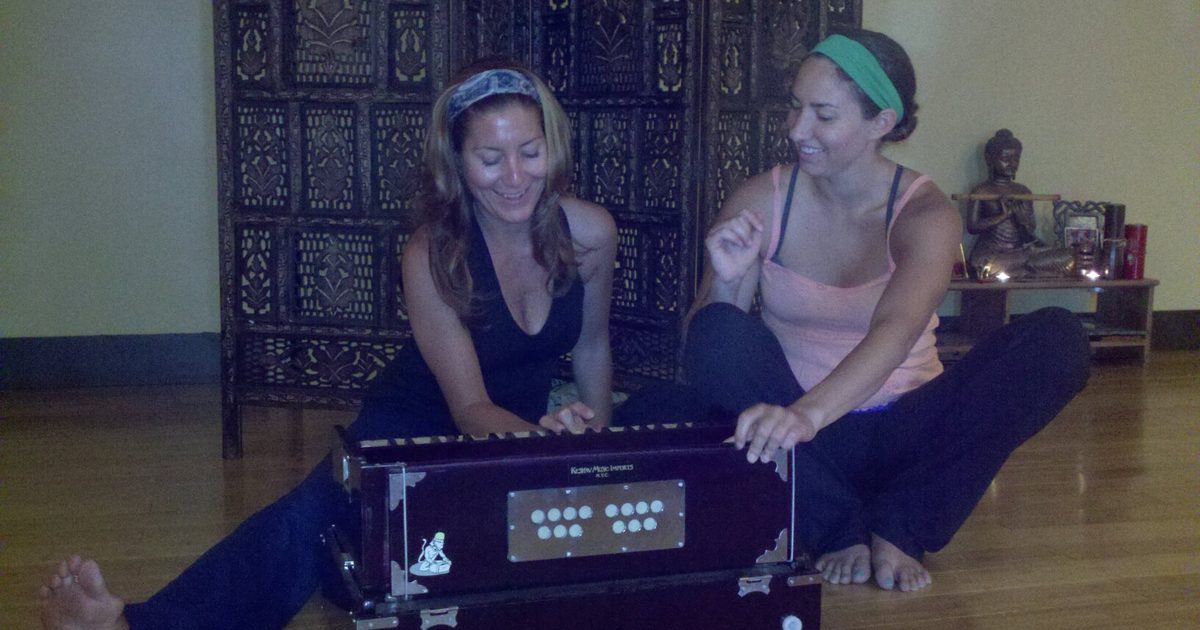
The practice is simple. A leader sings a mantra, usually accompanied by a harmonium and drums. The group sings it back. The pattern repeats, slowly building and softening, until the mantra seems to sing itself.
There’s no performance and no audience. Everyone in the room is part of it.
Where does kirtan come from?
Kirtan comes from India and the bhakti tradition. The classical texts describe many forms of devotion, and hearing and chanting the names of the Divine are among the first listed.
In sixteenth-century Bengal, the saint Sri Chaitanya Mahaprabhu took kirtan out of the temples and into the streets. His teaching was that in a chaotic time, people singing the sacred name together is the medicine. The community itself becomes the healing.
That idea still feels true to me today.
What happens at a kirtan?
Every gathering is a little different, but the shape is always simple:
- Settling in. You sit on the floor with cushions and mats, or in a chair if that’s more comfortable.
- The call. The leader offers a mantra with harmonium and voice.
- The response. The room sings it back together.
- The return. The mantra repeats, often for many minutes, sometimes speeding up and slowing down.
- Silence. Between mantras, there’s often a pause. Many people say the silence after a chant is their favorite part.
Most mantras are in Sanskrit. You don’t need to know what they mean, though the leader often shares a little about each one.
Do you have to be able to sing?
No. I promise. You don’t need a beautiful voice, you don’t need to know Sanskrit and you don’t need to have practiced yoga before. You need your voice, exactly as it is.
And if you don’t feel like singing, you can listen. In the bhakti tradition, hearing is listed even before chanting as a form of devotion. Listening is also practice.
What does kirtan feel like?
People describe it in different ways:
- Calm and quiet inside, even while singing loudly
- A feeling of connection with everyone in the room
- Joy, sometimes unexpected and a little silly
- Emotion, sometimes tears
- A meditative state that feels easier to reach than sitting in silence
For people who find seated meditation hard, kirtan can be a doorway. The melody gives the mind something to hold onto.
What is the Maha Mantra?
One of the most well-known mantras sung at kirtan is the Maha Mantra, or “great mantra”:
Hare Krishna Hare Krishna, Krishna Krishna Hare Hare, Hare Rama Hare Rama, Rama Rama Hare Hare
It’s traditionally offered as a way through the confusion of our age, like a rope of sound to hold onto when life spins fast.
What to bring to kirtan
- Comfortable clothing, since you’ll sit on the floor
- An open heart, the only skill required
- Your voice, exactly as it is, even if you haven’t sung since childhood
- Your own instrument, if you play one. Drums, shakers, singing bowls and tambourines are all welcome.
- A donation, if you’re able. Our kirtan is offered on a donation basis.
Kirtan and the breath
Something lovely happens physically when we chant together. Singing a long mantra naturally slows the breath and lengthens the exhale. Many people notice their shoulders drop and their body settle without trying. The harmonium keeps a steady drone, the drum keeps the pulse and the voice keeps the intention. Together, they create a container where the mind can finally rest for a while.
That’s why I often recommend kirtan to students who say they can’t meditate. You don’t have to sit still and quiet your mind. You just have to sing, and the stillness tends to arrive on its own.
Is kirtan religious?
Kirtan comes from a devotional tradition, and the mantras are names of the Divine. At the same time, people of every background come to kirtan, and you’re welcome however you relate to it. Some experience it as prayer, some as meditation and some simply as the joy of singing with others. All colors, races, ages, genders, religions, abilities, sizes, cultures and people are welcome.
Kirtan in Rockville Centre
Monthly kirtan is back at Revolution Yoga, in our main studio at 7 North Village Avenue in Rockville Centre. We gather on the third Saturday of each month. The next kirtan is Saturday, October 17 at 5:00 pm, and you can reserve your spot on the schedule.
If you love it, you might also enjoy our sound baths and other events, or our community classes, which are also donation-based.
Come sing with us
Bring your voice. Bring your friends. Bring your quiet. There’s a place in the circle for you.


