A few years ago, the answer to “how do I become a yoga teacher?” was simple: find a studio near you and show up for a lot of weekends. Now you can train from your kitchen table, from another country, or in a hybrid of both.
That’s great news. It also makes the choice harder. I’ve run both in-person and online trainings, and I can tell you honestly that neither one is better for everyone. They’re different. The right one depends on your life, your learning style and what you want out of it.
Here’s how I’d think it through.
First, the non-negotiables
Whatever format you choose, check these things first:
Is it a Yoga Alliance Registered School? Look for “RYS-200.” It means the program meets Yoga Alliance’s standards for a 200-hour training, and graduates can register as RYT-200. Many studios look for this when hiring.
Who are the teachers? Look for lead trainers with real years of teaching and training experience, and ask who teaches which modules.
What’s in the curriculum? A solid 200-hour program covers asana (poses), anatomy, philosophy, meditation, pranayama (breathwork), teaching methodology and practice teaching. Ours also includes Ayurveda, kids yoga foundations, prenatal yoga, the sound of yoga and the business of yoga.
Will someone watch you teach and give you feedback? This is the part that actually makes you a teacher. Make sure there’s real, personal feedback built in, not just a final quiz.
Once those boxes are checked, format is where your life comes in.
The case for in person
There’s something about being in a room together that’s hard to replace.
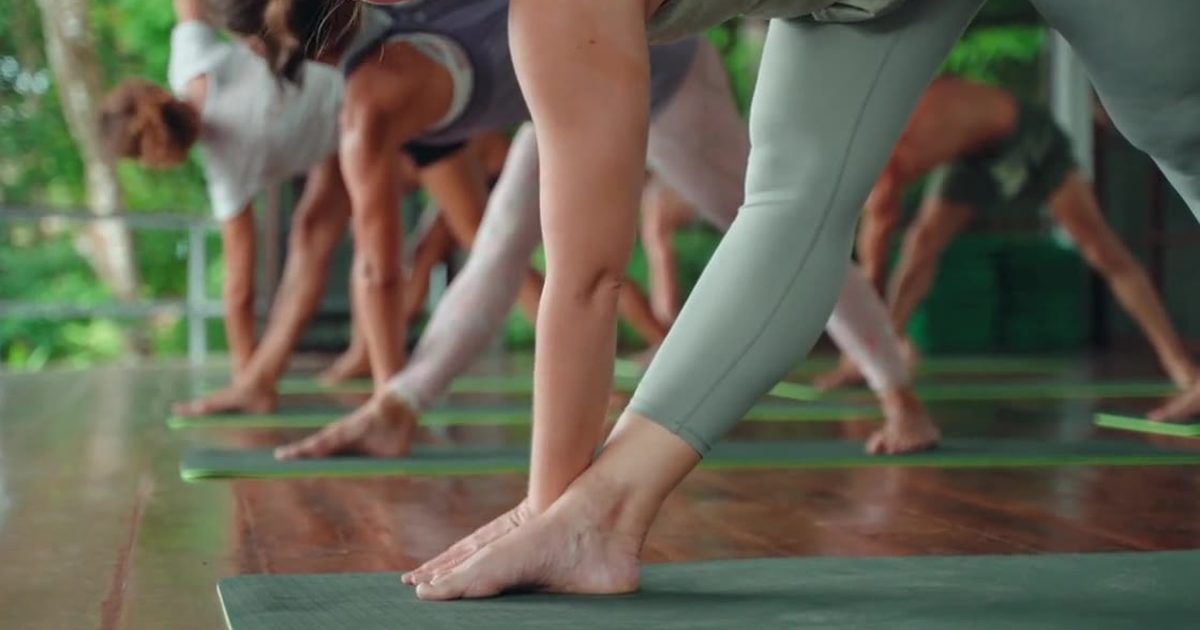
You get hands-on learning. Your teacher can see your body in a pose from every angle, and you can practice teaching on real bodies in a real room.
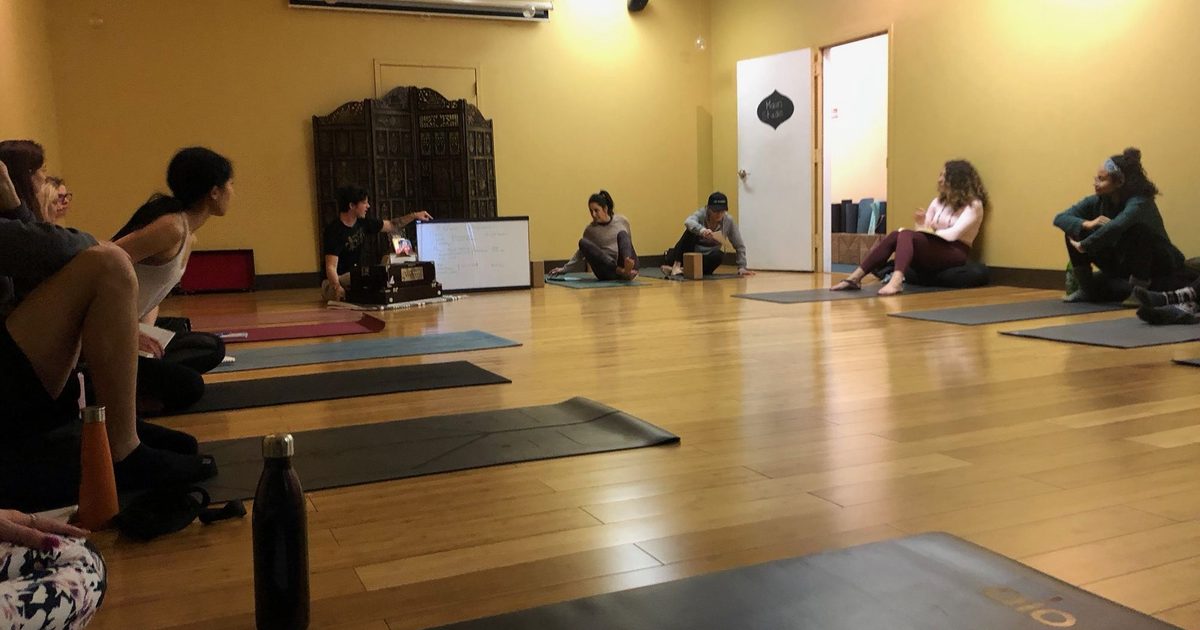
The community is deeper. Sharing tea on a break, practicing side by side, staying late to talk about something that came up. This is where lifelong friendships come from. Many of our in-person cohorts stay close for years.
You learn to hold a room. Teaching live, with real people breathing in front of you, is a different skill from teaching to a camera. In-person training gives you a lot of practice at it.
It creates structure. If you know you’ll let things slide without a schedule, a set weekend or Sunday commitment keeps you on track.
The tradeoffs: you need to live close enough to get there, your schedule has to match the training dates, and in-person programs usually cost more because of studio time and more live teaching hours.
The case for online
Online training has come a long way, and for many people it’s the only way training is possible.
You can do it from anywhere. No commute, no childcare puzzle, no travel costs.
You set the pace. Self-paced programs let you move faster when life is quiet and slow down when it isn’t. Some people finish in a month. Others take most of a year.
You can rewatch everything. Anatomy the second time through makes a lot more sense.
It usually costs less. Without studio overhead, online programs are often much more affordable.
The tradeoffs: it takes real self-discipline, you’ll miss some of the in-the-room energy, and community takes more effort to build. The best online programs make up for this with live sessions, mentorship and teacher feedback on your practice teaching.
The hybrid option
This is the middle path, and it’s the one many people end up loving. You get live, in-person days for the parts that benefit most from being together (practice, teaching, community) and online learning during the week for study at your own pace.
Questions to ask yourself
- How do I learn best? Do I need a teacher in the room, or do I focus better on my own?
- What does my calendar actually look like? Be honest about work, kids and other commitments.
- Do I want a close cohort? If community is a big part of why you’re doing this, weigh in-person or live-online more heavily.
- What’s my budget? And does the program offer payment plans?
- Do I plan to teach in person? If so, some in-room teaching practice is valuable, even if you do most of your study online.
How we do it at Revolution Yoga
We offer our Yoga Alliance registered 200-hour training three ways, all with the same core curriculum and the same certification:
Self-Led Online. Enroll and start any time. Recorded modules in Google Classroom, written materials, assignments, a peer community and teacher feedback on your practice-teaching submissions. Up to 12 months to finish. $397 launch price through October 31, 2026 (regularly $777).
Online Cohort. Everything in Self-Led, plus live online Sunday sessions with your cohort beginning October 2026 (join live or watch the replay) and personal mentorship on your practice teaching. Join from anywhere. $1,444 launch price through October 31, 2026 (regularly $1,777).
In-Person Hybrid. Our next live cohort starts Sunday, October 18, 2026, at our studio in Rockville Centre, NY. Full Sundays in the studio, plus the online portal during the week, with make-up sessions and recordings if you miss a weekend. Offered in English or Arabic (Arabic via Zoom). $3,333, with an $800 deposit to reserve your spot. Payment plans, no-interest financing and scholarships are available.
Not sure yet? That’s what our free 20-minute consultation call is for. You’ll talk with a faculty member, ask anything you want, and get an honest answer about which path fits you. No sales pitch.
We also offer a 300-hour advanced training for graduates who want to keep going, and specialty trainings in prenatal, yin, restorative and more.
There’s no wrong door
People sometimes worry that choosing online means getting “less.” It doesn’t, as long as the program is solid and you show up for it. And people sometimes worry that in person means they have to rearrange their whole life. Often it’s more doable than it looks.
Pick the format that you’ll actually finish. That’s the one that’s right for you.
Find your path
Take a look at all of our training options side by side, including dates, formats and tuition.
Compare our yoga teacher trainings
Or go straight to the details of the 200-hour training.