People often assume restorative yoga is the easy class to teach. You set out a few bolsters, dim the lights and let everyone lie down, right? Then they try it, and they realize how much skill it takes to help a room full of tired, busy people truly rest. If you’re wondering how to become a restorative yoga teacher, this is what I’d want you to know first.
What is restorative yoga?
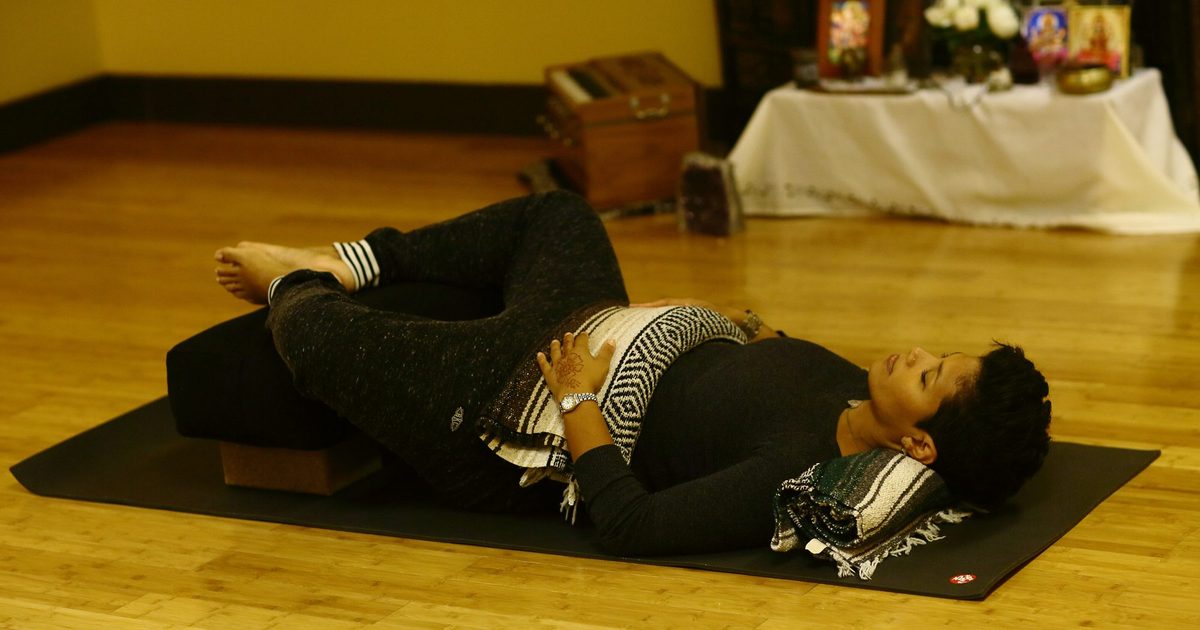
Restorative yoga is a passive practice where the body is fully supported by props in each posture. Bolsters, blankets, blocks, straps, chairs and the wall hold you, so your muscles don’t have to. Poses are held for a long time, and the whole practice is designed to help the nervous system settle.
In our studio, restorative classes also include guided relaxation, gentle hands-on adjustments at marma points (Ayurvedic energy points) and yoga nidra at the end.
Why restorative teaching is a real skill
In a flowing class, momentum carries people. In restorative, there is nothing to hide behind. The teacher’s job is to create the conditions for rest, and that asks for:
- Precise propping. A pose that is almost comfortable won’t let someone let go. A good teacher sees the gap under a knee or a neck and fills it.
- A settled presence. Students pick up on your energy. If you’re rushed, they’ll feel it.
- Voice and pacing. When to speak, when to go quiet and how to bring people back gently.
- Emotional awareness. Deep rest can bring up feelings. You hold space without fixing.
- Trauma awareness. Lying still with eyes closed doesn’t feel safe for everyone. You offer choices.
That’s why I always say restorative yoga requires more presence, not less.
Do you need a 200-hour certification first?
Not to study it. Our restorative training is open to yoga teachers, wellness professionals, caregivers, therapists, bodyworkers and dedicated students. Some people take it simply because they are burned out and want to learn how to rest.
If you plan to teach public classes at a studio, most studios will want a 200-hour foundation as well. A restorative training is a beautiful specialty to add on top of that.
Step by step: becoming a restorative yoga teacher
1. Receive restorative yoga regularly
Take classes. Notice which props make you feel held and which leave you fidgeting. Pay attention to how the teacher’s voice lands. You’ll learn a lot just by being a student. We offer restorative classes several times a week, in studio and by livestream.
2. Study the nervous system
You don’t need to be a scientist, but you should understand the basic relationship between stress, rest and the parasympathetic nervous system. It helps you explain why this practice matters and how to structure a class that actually calms people down.
3. Learn props inside and out
Practice setting up every pose on yourself and on friends. Learn how to use bolsters, blankets, blocks, straps, chairs and the wall. Learn how to adapt when a student can’t get to the floor.
4. Learn restorative sequencing
A restorative class still has an arc. You might begin with grounding breath, move through a small number of supported shapes and end with deep relaxation. Knowing why each pose comes where it does makes all the difference.
5. Practice holding space
Teach friends. Teach family. Teach yourself out loud. The quiet takes getting used to.
What a restorative yoga teacher training should cover
Our Restorative Yoga Teacher Training has eight modules:
- Foundations of restorative yoga
- Nervous system regulation
- Supported postures and prop usage
- Restorative sequencing
- Breathwork and meditation
- Trauma-aware and inclusive teaching
- Hands-on adjustments and an introduction to marma points
- Teaching methodology: voice, pacing, cueing and atmosphere
If a training you’re considering skips the nervous system or trauma awareness, I’d keep looking.
Can you take a restorative yoga teacher training online?
Yes. Ours is offered entirely on demand. You get recorded modules, practice demonstrations of every supported pose, guided restorative classes you can take yourself, sequencing templates and downloadable manuals, scripts and prop guides.
The details:
- Tuition: $247
- Access: lifetime access to all modules and updates
- Pace: yours, with no deadline
- Start: the same day you enroll
- Certification: Restorative Yoga Teacher Certification on completion
- Continuing education: Yoga Alliance CE credits for current RYTs
What graduates tell us
One graduate came in thinking restorative was “easy yoga” and left with a whole new relationship to her body and her work. Another came to the training burned out and said she left knowing how to rest as a discipline. That’s the part I love most. The training supports your students, and it supports you.
Is restorative the same as yin?
No, though they’re often confused. Yin places gentle stress on connective tissue with long passive holds. Restorative supports the body fully so the nervous system can recover. If yin interests you as well, we also offer a yin yoga teacher training.
Begin when you’re ready
In a world that rewards pushing, teaching people how to rest is a real gift. If you feel called to it, you can enroll today and start right away.