“Every moment is the guru.”
Charlotte Joko Beck
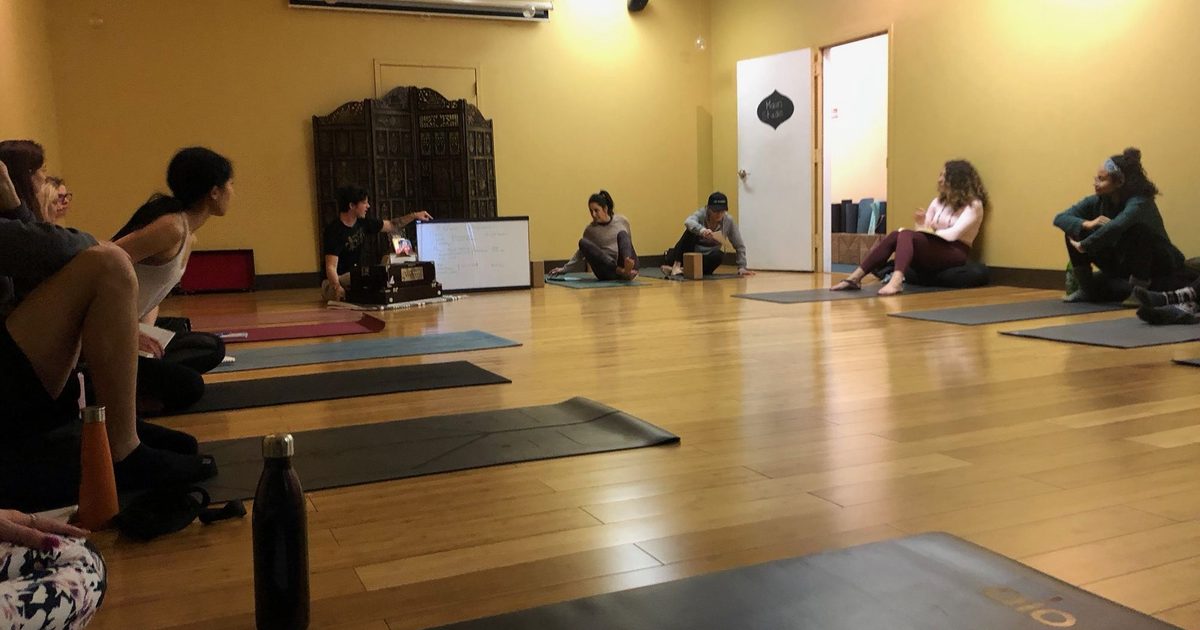
I walked toward the back of the studio, still humid from the class before, and rolled out my mat. I’ve always enjoyed those quiet moments before class begins, watching people decide what to do with themselves in the silence. Some don’t agree with silence and make conversation or scroll their phones. Others lie peacefully on their mats with their eyes closed, shutting out the room.
This particular space felt almost ethereal. Sunlight streamed through gauzy curtains, silhouetting yogis floating slowly into handstands and splits and melting effortlessly into deep backbends and binds, and class hadn’t even begun. A scene like that can mesmerize and terrify at the same time. Watching them, I wasn’t sure what to expect. Up to this point, the hardest pose in most of my classes had nothing to do with standing on my hands.
A prayer for our teachers
The teacher walked to the front of the room, unpacked his harmonium and began to play. He invited us to chant OM with him, then flew into a torrent of Sanskrit I couldn’t understand. I was so curious, and so impressed. He said it was a prayer for our teachers. Little did I know he would become one of my most important teachers, and that I would follow him around the world on the path to finding myself. He began every class this way, and not until I took his master training did I learn what the prayer meant:
I offer my respectful gratitude unto my teachers, who have opened my eyes, blinded by the darkness of ignorance, with the torchlight of knowledge.
He began every day with this acknowledgment. Yes, I had been grateful to some teachers in my life. My high school English teacher, for sitting with me for hours discussing travel, literature and the meaning of life. My tough-as-nails boss when I was an EMT at Jones Beach, for never letting me get away with anything; he taught me a discipline I could not have learned anywhere else. My parents, for pouring their hearts and knowledge into raising me, exposing me to art, music, drive and self-inquiry. But I didn’t make a point of reminding myself to be grateful every day.
We can’t own anything
When you start to think about it, we take a lot for granted. We try to take ownership instead. We patent ideas so others can’t steal them, lock away our possessions so others can’t use them, draw property lines so others can’t trespass, copyright texts so we can “own” them. But the reality is that we can’t truly own anything. No matter how tightly we hold on, it all gets taken away. The car in my driveway will be rust in a hundred years, returned to the earth. The yoga studio I’ve built, whether in 300 years or by fire tomorrow, will crumble to the ground. Even this body carrying me around is so temporary. It’s all just on loan.
We become possessive not only of things but of ideas, when the truth is that our ideas don’t come from us. Everything I know, I learned from someone or something else. My opinions and my way of seeing the world are conditioned responses, shaped by what my teachers have taught me.
Every experience is a teacher
A teacher doesn’t have to look like your high school English teacher. It could be a really difficult experience that taught you something important about yourself. It could be a joyful experience that brought you to where you are now. It could be hitting rock bottom, to the point where you can barely fathom staying alive, and yet you do, and suddenly your mind gets very quiet, observant and reverent.
The yogis say the most important lesson is tada drashtuh svarupe avasthanam (Yoga Sutra 1.3): then the seer abides in its own true nature. Not our possessions, not our occupations, not our desires. Just as we are: the beautiful, perfect, blissful witness. Deepak Chopra put it simply: we are human beings, not human doings. All the disciplines come back to this basic idea, and the teacher of experience, which sometimes feels like being hit in the face with a brick, is trying to wake us up to this state of witnessing, of being. These teachers are trying to open our eyes to the light of what is.
The poet Kahlil Gibran said it best: “I have learned silence from the talkative, toleration from the intolerant, and kindness from the unkind; yet, strange, I am ungrateful to these teachers.”
A month of gratitude
Can we make this month a meditation on gratitude for the experiences that revealed our current state to us? Can we shift our mindset from “Woe is me, look at all I’ve endured” toward “Look at all I’ve endured, look at how it shaped me. I am so blessed”? And how can we excavate the meaning of each experience, the gift of a lesson learned?